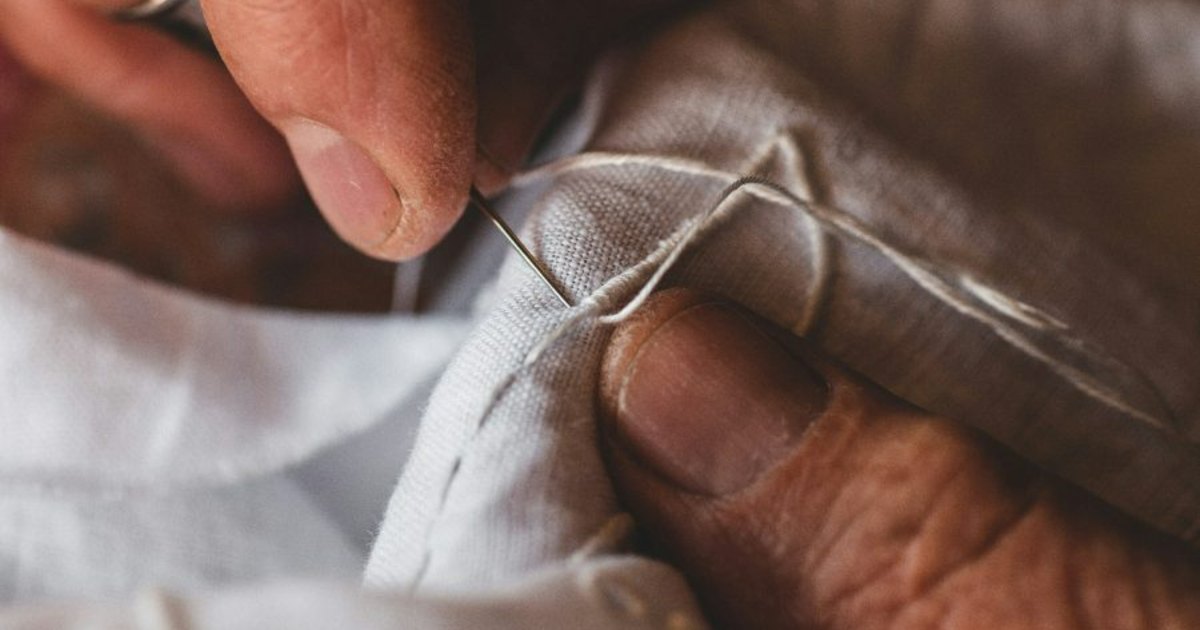
A button missing, a knee blown out, an elbow worn through. Most wardrobes lose more clothes to ten minutes of un-fixed damage than to actual wearing-out. Visible mending is the most useful set of skills you can teach yourself this year — slow, satisfying, and the difference between a five-year garment and a five-decade one.
Why visible mending
"Invisible" mending — matching the original thread, reproducing the original weave — is the work of a specialist tailor and isn't worth doing on most garments. Visible mending takes the opposite approach: the repair becomes part of the design. The Japanese textile tradition of sashiko (literally "little stabs") makes a feature of contrasting white running stitch on indigo cloth; the British darning tradition treats the repair as a small act of patience. Both produce garments that last decades and read, frankly, beautifully.
The other reason is psychological. A garment that has been visibly mended once is much more likely to be mended again. The first repair removes the shame; every subsequent one becomes routine.
A starter kit
You will not need a sewing machine. Everything below fits in a tin and costs less than a single new T-shirt.
- Sharps needles, sizes 5–9. Sharps are the all-purpose hand-sewing needle. Buy a mixed pack.
- Embroidery needles, size 7. Larger eye, for thicker thread.
- Sashiko thread or stranded cotton. Sashiko thread is matte, slightly twisted, and made for this; stranded cotton (six-strand floss) is cheap and works fine. Pick three colours that contrast clearly with your most-mended garments.
- Darning mushroom or a wooden egg. Anything smooth and rounded that fits inside a sock or jumper to support the repair.
- Sharp scissors — small, embroidery-sized.
- Pins — for holding patches in place.
- Iron-on interfacing — light-weight. Stabilises tears before stitching.
The five repairs
1. The button replacement
The five-minute repair that saves more shirts than any other. Position the button using the original thread holes, sew with double thread through all four holes in an X pattern, then wind the thread under the button five times to make a "neck" — that's what stops the button popping off again. Knot tightly underneath.
Use when: any button is missing or hanging by a thread.
2. Sashiko-style running stitch (reinforcement)
The right repair for thinning fabric — a knee about to go, a worn-out armpit. Lay a thin patch of contrasting fabric on the underside, then run rows of small, even stitches across the area. The stitches do the structural work; the patch is just there to hold them. The geometric patterns of traditional sashiko (waves, mountains, asanoha) aren't decoration — they distribute stress evenly.
Use when: the fabric is thin but not yet torn.
3. The darn (woven repair)
For holes in knitwear. Stretch the area over a darning mushroom. Make a "frame" of long parallel stitches across the hole. Then weave perpendicular threads in and out of the frame, like a tiny loom. The result is a small woven patch that grows with the garment. Practise on a sock before attempting a beloved jumper.
Use when: there's an actual hole in a knit.
4. The patch
For larger tears, especially in jeans or workwear. Cut a patch slightly larger than the hole. Iron a square of light-weight interfacing on the inside to stabilise the area. Pin the patch over the front, and stitch around the edges with a sashiko running stitch — straight lines or geometric pattern. A traditional boro patch is layered: many small patches, stitched over each other, deliberately uneven.
Use when: the tear is too big to darn (anything over an inch).
5. The seam re-stitch
The most overlooked repair — and the most common cause of "I can't wear this anymore." A burst seam is forty seconds with a needle. Turn the garment inside out, line up the seam edges, and use a small, tight back-stitch along the original seam line. Knot at both ends.
Use when: a side seam, hem or sleeve seam has popped.
How to mend a hole in a t-shirt
The most common repair anyone actually needs, and the one people throw t-shirts away over. Jersey is stretchy, which makes it slightly different from mending a woven shirt — the repair has to move with the fabric or it will pull and tear again beside the stitches.
That is darning, and on a t-shirt it takes about fifteen minutes. The interfacing is the step that makes the difference: without it, jersey curls at the cut edges and the repair puckers.
For a hole at a seam rather than in the middle of the fabric, do not darn it — restitch the seam. It is quicker and stronger.
Do mended clothes actually look good?
Honest answer: an invisible repair looks like nothing, which is the point of it, and a visible repair looks good if you decide it is going to.
The difference between a mend that reads as care and one that reads as damage is almost entirely about commitment. A hesitant repair in thread that nearly matches looks like an accident. The same repair in deliberate contrast — a bold running stitch, a patch chosen rather than found — reads as a decision.
So pick one and commit. Either match the thread exactly and let the repair disappear, or go properly contrasting and let it show. The middle ground is the only place this goes wrong.
Beyond aesthetics, there is the arithmetic: a garment you repair and keep wearing keeps lowering its cost per wear, and WRAP's 2025 research found around 82% of repairs replace a purchase that would otherwise have happened. A mend is the single most effective thing in this whole article.
Choosing the right repair
For most damage, the question is just: hole, tear, thinning, or seam? Use the table below as a quick reference.
- Button missing → button replacement.
- Hole in a knit → darn.
- Hole in woven fabric, under an inch → darn or small patch.
- Hole over an inch / tear in jeans → patch.
- Thinning fabric (about to go) → sashiko reinforcement.
- Seam popped → seam re-stitch.
- Moth holes in cashmere → darn, fine thread, take your time.
Trousers that need re-hemming, broken zips, lining replacement, anything tailored that you wear often. Hand mending is rewarding; spending two hours on a zip is not. A good tailor charges less than you'd think.
Workshops & classes
Fashion Fusion CIC is preparing a programme of repair workshops across Doncaster — keep an eye on the Fashion Fusion CIC site for dates as they're announced. We're also planning to spotlight other repair-makers and visible-mending educators doing brilliant work across the UK; that directory will appear here in time.
If you're not local, the Visible Mending Programme by Tom van Deijnen and books by Hikaru Noguchi (Darning) and Kate Sekules (Mend!) are excellent introductions.
In the app
Closet Remix doesn't mend for you, but it does make mending pay: cost-per-wear lives on every item and updates as you log wears — so a garment you repair and keep wearing visibly keeps earning its place. A repair guide inside the app is something we're exploring.
Mending is the most underrated lever in any wardrobe — it earns its place quietly, garment by garment.
Common questions
How do I start mending clothes?
With a tin of kit that costs less than a new T-shirt and no sewing machine: sharps needles in sizes 5–9, an embroidery needle, sashiko or stranded cotton thread, small scissors and a few scraps. The five repairs in this guide cover most of what goes wrong.
What is visible mending?
Repair that shows itself rather than hiding — contrast thread, deliberate stitching, patches placed as decoration. It is easier than invisible repair, it lasts as well, and it treats the mend as part of the garment’s history.
Is mending actually worth it?
Measurably, yes. WRAP found in 2025 that around 82% of repairs replace a purchase that would otherwise have happened — so a mend is one of the few sustainable actions with evidence behind it rather than good intentions.
How do I fix a hole in a t-shirt?
Press a small piece of iron-on interfacing to the inside over the hole to stop the jersey curling. Then darn it: start on sound fabric well clear of the hole, work small running stitches in rows across it, then rows at right angles, weaving over and under. Keep the stitches loose so they stretch with the fabric. About fifteen minutes. If the hole is at a seam, restitch the seam instead — quicker and stronger.